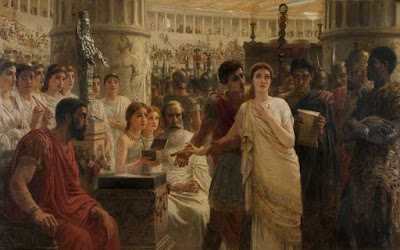
Years ago I was gripped by my first sight of this arresting picture by the Victorian artist Edwin Longsden Long, entitled “Diana or Christ?”
This dramatic and, at the time, very popular picture is evocative of the pressures that were placed upon early Christians to conform to the religion of the day. The ugly form of the many-breasted Diana is on the left. She was a blatantly pagan goddess, also known as Artemis, with prominent headquarters in the ancient city of Ephesus.
The artist imagines a scene later in time where a young girl – who has the light shining on her and takes centre stage – is presented with an ultimatum to worship Diana, or else. We see the hard-faced acolytes of this goddess looking on from around the horrible statue, impatiently waiting for the girl to submit. Just a pinch of incense is all that is required to signal her allegiance to the goddess! Her boyfriend is begging her to conform and save her life. The town recorder pitilessly reads out to her the charge of blasphemy against the goddess. The priest of Diana, seated, looks venerable but menacing at the same time. Two young children, still in their innocence, stare wide-eyed at this girl, failing to comprehend why she will not worship their goddess. Soldiers mingle around, steeling themselves to receive orders to execute the girl if and when she fails to comply with the demands of the authorities. Maybe she will be killed publicly to entertain the crowd behind.
When the apostle Paul visited Ephesus, he was seen as a rival to this established Diana cult. We read about this in Acts 19. Those who profited by selling trinkets relating to Diana perceived a danger to their trade. They set up a huge demonstration at which the clamour went up for two hours:
“Great is Diana of the Ephesians!”
Paul was surely fortunate to escape with his life from that place.
It seems to me that we are facing exactly the same choice as the girl – Diana or Christ? – in today’s Britain. The goddess figure today might not be Diana, but it is something equally secular and degrading. There are the siren voices telling us that we must be even-handed with all minorities, whether they obey God’s law or not. Then there are those forced to go along with corruption or exploitation in the workplace. In all these different ways we are expected to compromise – to offer that little pinch of incense to Diana. Will we choose her – or will we choose Christ? You wonder whether there is anybody left who is willing to make the unpopular choice of the Lord Jesus Christ. Yet make it we must, if we are not to betray than those who have gone before us in the faith. They held out amid great provocation and great oppression. They kept a clear conscience and a consistent witness for Christ.
It is not as if what they went through took them by surprise. The Lord Jesus Himself prophesied that persecutions would take place. He promised no cushy outcome even for those who were the most prominent in His service. The rewards will be worth every trouble, but will only be fully realised in the life to come.
Do we trust in the life to come where everything is put to rights? We too often have a wrong perspective – basically kidding ourselves that this life is all there is, and we had better feather our own nest as far as possible in order to get the best enjoyment out of it. This would be a grave mistake. A life beckons where we spend eternity in the company of our Saviour in heaven.
The apostle Paul writes:
Therefore I endure everything for the sake of the elect, that they also may obtain the salvation that is in Christ Jesus with eternal glory.
The saying is trustworthy, for:
If we have died with him, we will also live with him;
if we endure, we will also reign with him;
if we deny him, he also will deny us;
if we are faithless, he remains faithful—
for he cannot deny himself.
2 Timothy 2:10-13 ESV
Every time I open my mouth to speak I feel as though I am walking a tightrope. One way there is the pitfall of saying too much and the other way there is the pitfall of saying too little.
It is very easy to say too much. The wise sages all down the years have produced many shrewd sayings about this danger and the results that can sometimes follow.
By saying too much you can do a great deal of damage. It is amazing the size of juggernaut that can be unleashed by a careless word. James, the brother of the Lord Jesus, compared the tongue to the rudder of a ship. It is relatively small compared with the vessel itself, but it can steer the whole of that vessel in whatever direction the pilot decides. I know that from my one brief experience of steering a vessel on water. It was an occasion where I was for a short while in charge of a narrowboat – I was at the tiller, in other words.
As a novice, I found myself always oversteering. The result was that the narrowboat took a zigzag course through the canal. I don't say the boat came to any harm. I did not go crashing into the canal bank or otherwise causing destruction. But I don't think the patient boat-owner who let me have a go at the tiller was particularly impressed by my skills. I hope to have another go soon as we look forward to a church outing on a narrowboat on the Kennet and Avon Canal.
My erratic course also illustrates another point that James makes in his letter. In his first chapter, James criticises the indecisive person – "double-minded, unstable in all his ways".
This double-minded character does not get what he asks for from the Lord. His problem is not just indecisiveness but a lurching between good and evil. About the tongue, James says this:
"... it is a restless evil, full of deadly poison. With it we bless our Lord and Father, and with it we curse people who are made in the likeness of God. From the same mouth come blessing and cursing. My brothers, these things ought not to be so. Does a spring pour forth from the same opening both fresh and salt water? Can a fig tree, my brothers, bear olives, or a grapevine produce figs? Neither can a salt pond yield fresh water" (James 3:8-12).
The other danger is in our saying too little. That way we may avoid saying the wrong thing, but if we look churlish that may equally send the wrong signals. Our silence can be as much of a weapon of mass destruction as the exercising of speech.
In order to truly use our tongue in the right way, the way that pleases God, we need His grace constantly. We need, in other words, following another piece of New Testament advice, to study how best to speak to each person we meet, and do it prayerfully.
May God help us in this precious work. It can bring enormous benefit where a hasty tongue would cause incalculable harm. It is also an excellent witness for Christ.
A church pastor I know explained to me one day how he was born into a non-Christian home. He found that non-Christians never seem to be able to avoid getting into shouting matches every time they have a difference of opinion. It clearly made a great impression on my friend that Christians see no need of this.

For most people, and for most of history, it has been a luxury to own a mirror. There were very few reflective materials of any quality in ancient times. Bronze was often used for mirrors among fashionable women in early civilisations. However, this was a rare commodity that only gave a fuzzy result. Being a luxury item it would not filter through to the poor.
Some years ago, I came across an inexpensive way of bringing delight to children in poorer parts of the world by giving them something that would reflect their face. For many this may indeed be the very first time they actually see what they look like! It was all to do with old CDs. I was about to have a whole consignment of them recycled. But one lady in the north of England found out and persuaded me to change my mind. Her church was taking old CDs, putting little stickers on the non-reflective side of them and attaching a ribbon whereby the CD could be pinned up on a wall. The reflective side, albeit with a hole in the middle, could be used as a mirror. What a brilliant way to add value to the shoeboxes full of gifts which were being sent out to these children for Christmas!
There are occasional references to mirrors in the Bible. One is from the apostle Paul. In 1 Corinthians 13 he describes our earthly selves as being like someone looking at a dim reflection in a mirror. By contrast, in heaven there will be complete transparency. We will see each other face to face, and we will know fully even as God fully knows us.
Another instance that comes to mind is an amusing reference from a letter of James, the half-brother of the Lord Jesus. He says that a person who hears God’s word but doesn't act upon it is like a man who sees his getting-up-in-the-morning face in a mirror. He looks himself up and down, but in the end he wants to forget that face. He has a perfunctory shave, turns away and immerses himself in the working day. The person who is obedient to God's will and purpose is like somebody who stoops down to look at all the truth God has given him. He really takes notice of it, weighs it up, and puts it into practice in his life.
This is what we should be like. It is easy to think we've completed our daily devotions, when really we've only been through the motions. God wants us not only to read His word, not even just to think it is impressive, but to take it on board and put it into practice.
The Lord Jesus always practised what he preached and urged others to do the same. He predicted he would be put to death, rise again and return to His Father in heaven. He undertook not to cut His followers adrift, but to make His death an offering for the ransom of many. Thank God that our Lord Jesus was not like the man who ran away from the reality that the mirror showed!
For now we see in a mirror dimly, but then face to face. Now I know in part; then I shall know fully, even as I have been fully known. 1 Corinthians 13:12 ESV
But be doers of the word, and not hearers only, deceiving yourselves. For if anyone is a hearer of the word and not a doer, he is like a man who looks intently at his natural face in a mirror. For he looks at himself and goes away and at once forgets what he was like. But the one who looks into the perfect law, the law of liberty, and perseveres, being no hearer who forgets but a doer who acts, he will be blessed in his doing. James 1:22-25
Since the disaster of the avalanche which engulfed a hotel in Italy, at least one lady has compared her rescue with being born again. It wasn’t glibly done, either: she explicitly credited God with her deliverance.
I may previously have referred to the words of Coxswain Frank Blewett of the RNLI when he described the steep ladder leading down to the survivors’ cabin:
“These are steps trodden by the reborn. When we have snatched a man out of the jaws of death, this is where he begins his second life.”
Going back to the lady in the hotel, I would guess that the word she used for “reborn” was “renata”. I believe this was a name fondly used by ladies in northern Italy as they made a brilliant discovery, or rather re-discovery, of a Bible truth. They did it as the new learning called the Renaissance blossomed throughout Europe. Re-examining their Bibles in a new light, they discovered that the real qualification for gaining eternal life was to be born again.
This basic truth had become lost or submerged for centuries. This was hardly surprising. When Jesus first uttered it, it caught out the Jewish law expert Nicodemus. In John 3 we learn that Jesus told him,
“Truly, truly, I say to you, unless one is born again he cannot see the kingdom of God” (John 3:3).
Nicodemus could not understand that these words should be interpreted in a non-literal way.
“How can a man be born when he is old? Can he enter a second time into his mother's womb and be born?”
Jesus explained:
“Truly, truly, I say to you, unless one is born of water and the Spirit, he cannot enter the kingdom of God. That which is born of the flesh is flesh, and that which is born of the Spirit is spirit. Do not marvel that I said to you, ‘You must be born again.’ The wind blows where it wishes, and you hear its sound, but you do not know where it comes from or where it goes. So it is with everyone who is born of the Spirit.”
Nicodemus still didn’t get it. Jesus expressed astonishment that a man of Nicodemus’s learning could not detect the inner meaning of His words, even after He had clarified it. He had to spell it out.
“No one has ascended into heaven except he who descended from heaven, the Son of Man. And as Moses lifted up the serpent in the wilderness, so must the Son of Man be lifted up, that whoever believes in him may have eternal life.”
People today make fun of the expression, “Born Again”, because they don’t understand it. As a result, Christians involved in outreach tend to shy away from it. Yet sometimes it strikes a chord. I remember one evangelist with Birmingham City Mission who would go up to people on New Street and ask them bluntly, “Are you born again?”. He had some quite interesting and profitable conversations as a result!
The new birth is no novelty. It goes right back to the teaching of Jesus Himself. Believers should welcome it as a key part of their heritage.
This new year, the Our Daily Bread notes brought home to me an intriguing truth: shepherds and kings have more in common than we realise.
We have just emerged from the Christmas season with its stories of the Bethlehem shepherds and the wise men (often depicted as Three Kings). We assume that the two groups are worlds apart. In many ways that's as it should be. It is an important truth that Jesus's magnetism attracts all sorts of people, the great and the humble alike.
Yet both shepherds and kings need a certain skill set in order to carry out their particular work well. A good, conscientious Shepherd will care for, control, govern and protect his flock. Surely a good king is expected to do no less?
Young David was a shepherd boy who also hailed from Bethlehem. When the prophet Samuel came to his father Jesse’s house in search of the man who should succeed Saul as king of Israel, he was out tending the flock. The last thing on his mind was ever becoming head of God’s people. Yet, guided by God, Samuel was unerringly prompted to choose and anoint him as the successor to Saul.
David’s wealth of pastoral experience soon came into its own. When God’s people were being taunted and threatened daily by the Philistine giant Goliath, it occurred to David that his shepherding skills might come in handy in saving the nation and restoring God’s honour. He duly felled Goliath using only the simple sling and stone that served him in warding off wild animals from his flock.
God arranged things so that David would have oft-repeated reasons to draw on his shepherd days for wisdom about kingship:
He chose David his servant
and took him from the sheepfolds;
from following the nursing ewes he brought him
to shepherd Jacob his people,
Israel his inheritance.
With upright heart he shepherded them
and guided them with his skilful hand.
Psalm 78:70-72 ESV
Amid all the fame and pomp and glory of kingship, King David never forgot the lessons taught him in his former calling. He saw God Himself as the ultimate role model for shepherds:
The LORD is my shepherd; I shall not want.
He makes me lie down in green pastures.
He leads me beside still waters.
He restores my soul.
He leads me in paths of righteousness
for his name’s sake.
Even though I walk through the valley of the shadow of death,
I will fear no evil,
for you are with me;
your rod and your staff,
they comfort me.
You prepare a table before me
in the presence of my enemies;
you anoint my head with oil;
my cup overflows.
Surely goodness and mercy shall follow me
all the days of my life,
and I shall dwell in the house of the LORD forever.
Psalm 23
Jesus the descendant of David, the Messiah, was supremely the Good Shepherd. Yet He is also described as a sacrificial Lamb! His death on the cross is a sacrifice atoning for our sins. In an extraordinary verse in Revelation, the risen Lamb once more becomes the Shepherd, looking after those faithful souls who have passed through the great tribulation:
For the Lamb in the midst of the throne will be their shepherd,
and he will guide them to springs of living water,
and God will wipe away every tear from their eyes.
Revelation 7:17
Thank God for a great Shepherd whose skills never become rusty through disuse. Will you place yourself under His sure protection?
Thought for the Day on BBC Radio 4 this morning (27 December) focused on confused people and the memories that held significance for them. A person with dementia might, for instance, remember carols and be able to sing them clearly when all else was confusion.
The Bishop of Leeds made, in passing, the point that it is a real loss when youngsters grow up without much knowledge of traditional carols. I'm sure he is right. All that is served up to the rising generation is a handful of carols popular in schools and shopping precincts. Many of these will be purely secular. Not much meaty content there to latch on to.
This sparked off in me a whole chain of thoughts. My mother once spoke of a dramatic experience in her 1930’s nursing days. One night a young man was seen pacing up and down a ward singing hymns at the top of his voice. He had no known church associations. By the morning that young man had died. Hymns - dragged up from somewhere in the recesses of his mind - came to the fore as his life systems began to shut down.
I personally remember a terminally ill man, who had become very anti-church and a long-time non-attender, asking for a hymn book he could sing from in his side ward. He explained how it was a comfort to him.
A number of Scottish people have told how they left church after their Sunday School days. During that time they had been trained in the Church of Scotland’s beliefs. These beliefs came back to them in times of crisis and were a comfort and a help.
And then there are the sobering examples of people clinging to much darker and less healthy influences in their closing days. A well-meaning but surely misguided lady told us of her experience visiting in a hospital ward for men. She noticed that the eyes of one elderly man lit up with recognition when a swear word was used. She saw how this wretched expletive helped him to concentrate. Thinking she was being helpful, she went round to other men on the ward and encouraged them to voice the same word. It had the same effect on them!
Even the most well brought up people can suddenly come out with bad language when in the throes of dementia. This causes great distress to friends and relatives who have never heard them use these expletives before.
In my view, swear words have demonic power and should be avoided like the plague. Hymns, on the other hand, can build us up and benefit us. So can verses of scripture. A number of famous people have died with some such words as
“Lord Jesus, receive my spirit”
(Acts 7:59 - the dying words of Stephen, the first Christian martyr) on their lips. Rev Charles Wesley passed away quoting, “I shall be satisfied with thy likeness”:
“As for me, I shall behold your face in righteousness; when I awake, I shall be satisfied with your likeness” (Psalm 17:15).
I have no control over what words I may babble if and when I come to that stage in my life. All I know is that I hope what I come out with will be hymns or Bible verses and not swear words.
The saying is trustworthy and deserving of full acceptance, that Christ Jesus came into the world to save sinners, of whom I am the foremost. 1 Timothy 1:15 ESV
What are people born for? Well, you might think, what a silly question! Couples may expect to start families, sooner or later. There may be some planning behind it; some wishes to fulfil. But usually it is not the result of a profound philosophical choice.
Of course, there may be incentives behind having children that don’t normally come to mind. We hear stories of “saviour siblings” being born. The intention is that they will one day provide healthy tissue that can transform the life of an older brother or sister whose existence would otherwise be blighted by some congenital abnormality.
What the baby will eventually think about this reason for its being born can only be imagined. It never had a say in the matter.
Before the advance of modern science, life was, if tragic, at least less fraught with moral dilemmas over what is right or wrong for the unborn child.
With the Lord Jesus, the supreme “Saviour sibling” in a family of mother, father, four boys and at least two girls (Mark 6:3), it was different. As Christians we believe in the pre-existence of Jesus before His life on earth. He was in glory. He and God the Father and God the Holy Spirit were in full agreement from all eternity about His eventual birth as a baby on earth and its purpose.
It would underline a theological truth: that Jesus was both fully human and fully God.
And it would not just be about abstract theology. He would be born
“into the world to save sinners”.
He also came to pass judgment on the rights and wrongs of the world:
“For judgment I came into this world,” He said, “that those who do not see may see, and those who see may become blind.” (John 9:39)
In other words, He would apply a litmus test that would show clearly who was on God’s side and who was not.
He also came to give abundant life to those who believed in Him.
“I came that they may have life and have it abundantly” (John 10:10).
The old carol “Good Christian men, rejoice” has it about right:
Good Christian men, rejoice
with heart, and soul, and voice,
give ye heed to what we say:
Jesus Christ is born today;
ox and ass before Him bow
and He is in the manger now.
Christ is born today!
Christ is born today!
Good Christian men, rejoice
with heart, and soul, and voice;
now ye hear of endless bliss:
Jesus Christ was born for this!
He hath oped the heavenly door,
and man is blessed for evermore.
Christ was born for this!
Christ was born for this!
Good Christian men, rejoice
with heart, and soul, and voice;
now ye need not fear the grave:
Jesus Christ was born to save!
Calls you one and calls you all,
to gain His everlasting hall:
Christ was born to save!
Christ was born to save!


